

Industrial overharvest of a fish we depend on keeps getting the green light
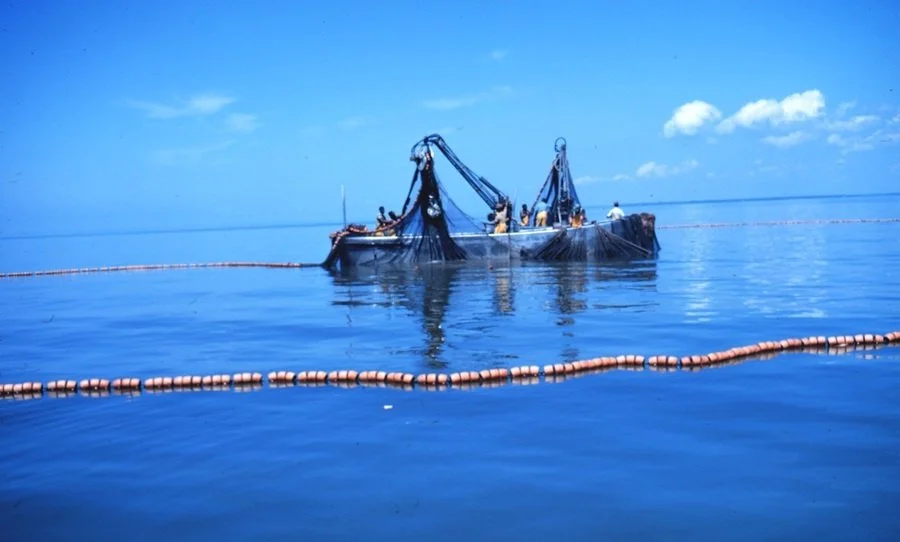
A photo from 1968, before the harvest of menhaden became as highly industrialized as it is today. (Photo by Robert K. Brigham/NOAA Fisheries Collection)
By Capt. Mike Rathgeber Nov 18, 2026
A decision was made last week regarding the management of menhaden that has everyone who cares about our fisheries and ecosystem in disbelief.
Menhaden are known by local fishermen as pogies and bunker, and they’re a crucial staple food source for striped bass, bluefish, tuna, red drum, ospreys, whales, and other marine wildlife. And as I’ve written here before, they are being severely overfished.
Yet the Atlantic States Marine Fisheries Commission, which regulates nearshore fisheries on the East Coast with representatives from 15 states, voted on Nov. 10 to reduce the total menhaden catch limit along the coast only very modestly. They’re beginning with a 9-percent cut in 2027 and going to a 17-percent cut in 2028.
Just how off is this? One of the options on the table when the commission opened public comment on this subject earlier in the fall was to reduce the industrial cap by half. The agency’s own science predicted that a cut of 40 percent would give menhaden a 50 percent chance of meeting their conservation target numbers, according to a Nov. 10 report in On the Water.
Think about this: the newly established quota is higher than what the industrial fleet was even able to catch in 2025. If that isn’t the definition of questionable conservation policy, then what is?
The consequences for America’s coastal ecosystems and fishing towns along the entire Eastern Seaboard cannot be good. If Atlantic menhaden were to be fished into oblivion, their absence would have monumental effects far beyond anything we can imagine.
You could say I’m an interested party, as the loss of these fish will affect recreational and commercial fishing, bait suppliers, charter businesses, and coastal tourism. But the effects of overfishing of menhaden go way beyond those interests, because menhaden is a fundamental food for fish and birds, equivalent to what rice and beans are to humans worldwide.
One example: Ospreys and their chicks depend on menhaden. In an article in the summer 2026 issue of Audubon, Bryan Watts, director of the Center for Conservation Biology at the College of William & Mary, who has been studying these birds in the Chesapeake Bay for more than 30 years, wrote that “Osprey chicks are starving in their nests. And the reason is simple. Their primary food source is menhaden. And that food source is no longer abundant. The fishery is saying there are plenty of menhaden; the osprey are saying something different.”
The Forage Fish Campaign, a nonprofit that’s bringing together fishermen and conservationists, declared the regulators’ decision another failure to address the evidence that a declining menhaden population is a reality. “We are watching the foundation of our marine food chain deteriorate,” wrote Whit Fosburgh, the organization’s executive director, on its website. Fosburgh previously led the Theodore Roosevelt Conservation Partnership, spent 15 years at Trout Unlimited, and was a wildlife specialist for the National Audubon Society.
The menhaden troubles are most evident in the Chesapeake Bay, where our striped bass’s troubles also begin. And that’s where the reaction is strongest so far. Nearly three-quarters of all Atlantic menhaden harvests are landed in Virginia, according to the Chesapeake Bay Foundation, a conservation nonprofit. The harvest gets turned into fish meal and fish oil, not bait or food.
The foundation and many others point out that there’s just one company, called Omega Protein, a subsidiary of Canadian-owned Cooke Inc., that dominates the industry, with massive fishing vessels, dozens of net-setting boats, and spotter planes. And a lobbying effort, of course.
Something stinks here, and it’s not the fish.