

Ospreys are disappearing along the East Coast. Scientists think they know why.
At the center of a widening crisis for one of the nation's great wildlife comebacks is a fish most Americans would hardly recognize.
By Mark Robichaux
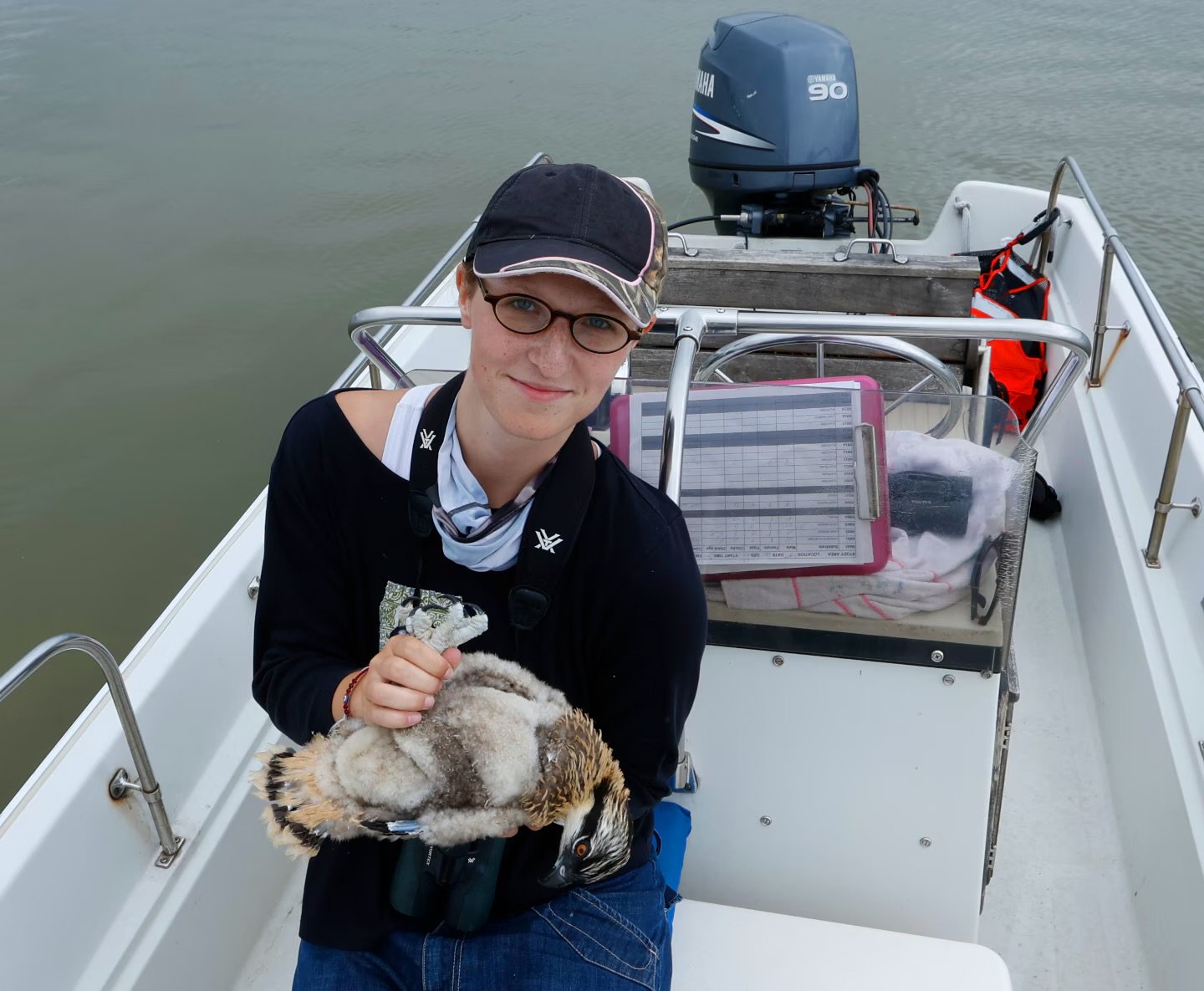
William & Mary undergraduate intern Lucia Hughes with young osprey on the Rappahannock River in Virginia. (Bryan Watts)
Bryan Watts has spent more than three decades watching ospreys reclaim the Chesapeake Bay, returning each spring from South America to crowd its tidal rivers and creeks, shorelines, channel markers and nesting platforms. The William & Mary biologist followed their recovery from the DDT era as the bay became home to the world’s largest breeding population of ospreys.
Now one of America’s great wildlife recoveries is coming undone. Across the Chesapeake this year, Watts and his colleagues at William & Mary’s Center for Conservation Biology recorded the worst osprey breeding season they have ever documented. Researchers working these waters have found chicks emaciated and starving in their nests.
A starving osprey chick can seem almost weightless — its breastbone sharp beneath feathers, its body too small for the nest around it. Three summers ago, Watts spent 3½ hours checking 81 nests on Mobjack Bay: empty nest after empty nest, with just three chicks at the end. Seeing a dead chick still gets to him, but what really stops him is absence. Watts drove home, he said, “with a sick feeling that something is clearly not right.”
The warning sign is no longer confined to the Chesapeake. Last week, Watts and his colleagues released the first picture of the 2026 breeding season up and down the East Coast: 2,886 osprey pairs in 65 study areas across 10 Atlantic states. Only 28 percent of saltwater study areas produced enough young to maintain their populations, compared with 93 percent of freshwater areas. The deficits extend from the Chesapeake through Delaware and New Jersey to Long Island and southern New England.
At the center of that widening crisis is a fish most Americans would hardly recognize. Atlantic menhaden are silver, oily and generally less than a foot long. Rich in fat and calories, they are the principal prey of Chesapeake ospreys and the nucleus of a food web extending far beyond the bay, including the fish humans do eat. Striped bass, bluefish, whales and seabirds feed on them; Maine lobstermen put them in traps.
A fight over menhaden has brought together an unlikely — and increasingly vocal — coalition. Recreational fishermen want menhaden in the water for the striped bass and other game fish that eat them. Charter captains need those predators to make a living. Lobstermen need menhaden for bait. Conservation groups want enough left for ospreys and other wildlife.
What remains uncertain is why menhaden aren’t there when birds and fishermen need them. Scientists are looking at several possible explanations, including commercial harvest and changing water conditions. Timing may matter, too: Osprey food demand has typically peaked from mid-May through mid-July, while in some recent years large numbers of menhaden haven’t arrived until weeks later.
But a growing number of critics have begun to focus on Omega Protein, which runs the Atlantic Coast’s last remaining menhaden reduction plant, located in Reedville, Virginia. The state receives about three-quarters of the entire Atlantic Coast menhaden quota, and roughly 90 percent of its share goes to the reduction fishery supplying Omega.
At the Reedville plant, menhaden are processed on an industrial scale into fishmeal, fish oil and other products. Its exclusive supplier, Ocean Harvesters, caught nearly 300 million pounds of Atlantic menhaden for the plant in 2024. That scale alone has made the fleet impossible to ignore in the debate over how many menhaden are being left for everything else that eats them.
Steve Atkinson, chairman of the Virginia Saltwater Sportfishing Association, argues there are no longer enough menhaden in the bay to support both industrial reduction fishing at its current level and a healthy ecosystem. Members of his group are seeing fewer schools of menhaden and catching fewer game fish, which is why they support cutting the bay harvest cap in half in the meantime. “We need action now, not five years from now,” he said.
Omega and Ocean Harvesters reject that conclusion, saying scientists have not established that their harvest causes local shortages or osprey failures. That dispute — over a fish neither side fully controls, eaten by a bird neither side can feed — is at the heart of the fight.
Ben Landry, vice president of public affairs for Ocean Fleet Services, the parent company of Ocean Harvesters, said in a statement that blaming osprey starvation on the menhaden fishery is “an oversimplified explanation for a complex ecological issue.” Water conditions, other prey, predators and habitat change all contributed to the birds’ decline, he added.
Watts himself describes the evidence as a strong association, not proof that commercial harvest caused the nesting failures.
Regardless of the exact cause, scientists have documented major shifts within the Chesapeake. In saltier waters, where ospreys depend most heavily on menhaden, 81 percent of nesting pairs failed to raise a single chick in 2026. Across those waters, four nesting pairs produced, on average, just one chick among them — far short of the rate needed to sustain the population. In fresher reaches, where ospreys can turn to catfish and gizzard shad, pairs produced enough young to sustain their numbers.
The food reaching the nests has changed, too. At some Chesapeake nests, Watts found, ospreys are bringing home menhaden more than 80 percent less often today than they did in the 1980s.
Anglers coastwide are seeing their own version of that shift. For 26 years, Chris Newsome made his living guiding fishermen on the Chesapeake from Virginia’s Middle Peninsula. A biologist by training, Newsome knows there will always be pockets of fish somewhere. What has disappeared, he said, is the ability to count on finding them. The good fishing comes in stretches that are “shorter and shorter and shorter.” For a charter captain, he said, what’s needed is “predictability.” This year, after what he called “the worst fishing in my lifetime,” Newsome closed his business and put his boats up for sale.
Fishermen up and down the Atlantic Coast describe the same increasingly uneven pattern: One community can be surrounded by menhaden, also called pogies or bunker, but more fishermen cite long stretches between sightings where they once reliably found them.
Off Virginia, spotter pilots search from the air for the dark stain of a menhaden school. Seine boats encircle the fish with massive purse-seine nets, close the bottom like a drawstring and pump the catch aboard larger vessels, including Ocean Harvesters’ new $9 million, 165-foot Tangier Sound. The fleet can also follow migrating menhaden north into federal waters, sometimes as far as New Jersey.
Reedville is the survivor of a once-sprawling industry. At its peak, more than 20 processing factories operated from Maine to Florida. As stocks contracted and states imposed restrictions, the plants disappeared; by 2006, Reedville was the only one left.
The corporate arrangement behind that fleet is unusual. Cooke, the Canadian seafood conglomerate that bought Omega for nearly $500 million in 2017, is constrained by a federal law that allows a fishing vessel to be owned by a company only if U.S. citizens own and control at least 75 percent of the company. Ocean Harvesters is 80 percent owned by Seth Dunlop, a U.S. citizen, Cooke employee and nephew of Cooke CEO Glenn Cooke; Omega owns 20 percent.
Most of the catch is reduced into fishmeal, fish oil and concentrated products rather than sold as food for people. Before Cooke took Omega private, federal filings identified Nestlé Purina PetCare as one of Omega’s biggest customers. Some Blue Buffalo and Purina pet foods list menhaden fish meal or oil among their ingredients, though the labels do not identify suppliers. Landry said in an email that most of Omega’s fishmeal and oil is sold domestically, including into pet food markets.
Most of Omega’s sales are domestic, with about 17 percent going overseas last year, according to Landry. Omega markets a concentrated menhaden product as an “attractant” for aquaculture feed pellets, and trade records reviewed for this story show its products shipped to Honduras, Indonesia and Vietnam. That rankles fishermen who see menhaden becoming harder to count on at home.
A menhaden left swimming is hard to value. But some of that hidden worth can be measured. A June 2026 study commissioned by the Theodore Roosevelt Conservation Partnership, an advocacy group, estimated that East Coast anglers spent $804 million in 2025 on trips using menhaden as bait, chum or scent. The estimate combines a survey of 1,316 anglers with federal fishing and spending data. For comparison, Omega says its combined Atlantic and Gulf operations generate about $300 million in annual sales, and Omega and Ocean Harvesters say their Virginia operations directly employ about 260 people.
Balancing those demands falls largely to the Atlantic States Marine Fisheries Commission, a 15-state body that manages menhaden along the coast. It classifies Atlantic menhaden as “not overfished” and says overfishing — fishing above the established threshold — is not occurring. But that is a coastwide finding. ASMFC says its assessment cannot tell whether menhaden are abundant enough in a smaller area such as the Chesapeake Bay.
Last year, the commission lowered its estimate of the menhaden population after revising a key estimate in its assessment: how many menhaden die of natural causes each year. ASMFC stressed that the change reflected a better understanding of the fish, not a decline in their numbers.
Jerald Ault and Jiangang Luo, University of Miami scientists whose reanalysis prompted that revision, now say even the revised estimate may be too high. “If natural mortality is set too high,” Ault said in a university statement, “the population can appear able to support more fishing than its biology allows.” ASMFC reviewed an earlier version of their analysis but not the final peer-reviewed paper.
The lack of definitive science has become an argument against tighter limits. Yet Virginia lawmakers have spent years failing to fund the research that could provide it.
In 2023, the General Assembly ordered the Virginia Institute of Marine Science to draw up a research plan for menhaden. Scientists, conservationists, anglers and industry representatives agreed on nine research priorities, including abundance and localized depletion.
But in each legislative session since, bills to fund that research repeatedly stalled. In 2026 alone, three different proposals failed to advance during the session: one to fund research aimed at understanding menhaden abundance in the bay, another to temporarily halt industrial fishing there, and a third to limit when and how the fleet could fish.
Omega says it never opposed the research. But a letter its lobbyist sent to Virginia lawmakers last year proposed replacing the full study with a two-year pilot or deferring it until 2026. Landry said that officials at the company believed full funding was no longer available by then and that the study as written was not scientifically sound research.
“The industry is now using that delay in definitive science as an excuse to stall new limits,” Chris Moore, the Chesapeake Bay Foundation’s Virginia executive director, said in an email. “The alarm bells in the bay keep getting worse. It’s mind-boggling.”
Landry, however, said the industry has helped fund preliminary research, given Virginia Institute of Marine Science researchers access to its vessels and “supported the research appropriation included in Virginia’s current budget.”
After the legislation failed again this year, Virginia Gov. Abigail Spanberger (D) kept the research alive through the state budget, and Virginia provided $2 million over two years for the Virginia Institute of Marine Science to begin the work. Meanwhile, the commission is now considering changes to the Chesapeake reduction cap ranging from no cut to a 50 percent reduction.
Omega and Ocean Harvesters oppose a 50 percent cut to the bay harvest, and Landry noted that regulators classify menhaden as “not overfished,” adding that tighter Chesapeake limits aren’t justified “without a demonstrated biological need.”
The fight extends to Louisiana, where Omega operates alongside Daybrook Fisheries, another menhaden-processing company. After three net failures spilled an estimated 850,000 fish in 2023, lawmakers strengthened tracking, enforcement and reporting. But a 2026 bill to move the fleet farther offshore and reduce other species caught with menhaden failed.
Back on the Chesapeake, the numbers keep getting worse. In the saltier reaches where ospreys depend most on menhaden, the birds’ reproduction has fallen for three straight years. If that continues, Watts projects the bay’s osprey population could fall by roughly half within a decade.
By September, the Chesapeake begins to empty of ospreys. The adults leave first; the young follow later, migrating alone, sometimes thousands of miles south. Those that survive will return next spring to the same rivers, the same navigation markers, sometimes the same nests.
For generations, that journey has ended with the same promise. They came home to the Chesapeake, circled above the water and hunted.
There were fish here.