

By Whit Fosburgh
There has been a lot of talk about menhaden’s role in the ecosystem and the broader topic of ecosystem management. So, let’s discuss what that means.
The first rule is that everything in an ecosystem is connected; what we do to one species will almost invariably have impact on another. In NOAA’s words “Ecosystem-based fisheries management is a holistic approach that recognizes all the interactions within an ecosystem rather than considering a single species or issue in isolation.”
This principle is important because of a growing body of science that warns of the danger of ecosystem overfishing. NOAA scientist Jason Link’s 2021 paper “Evidence of Ecosystem Overfishing in US Large Marine Ecosystems” looks at all eight distinct US marine ecosystems and concludes that most are in decent shape, except the Northeast US Continental Shelf from Maine to North Carolina, which is overfished, and the Gulf, which is likely overfished. In short, too many fish are being removed from the Gulf and the Mid-Atlantic/NE Atlantic to allow those ecosystems to function properly.
Now, what do the Gulf and the Atlantic have in common? Reduction fishing. This is the practice of catching large volumes of baitfish with spotter planes, mother ships, chase boats, massive purse seines, and large vacuums to pump the fish on board. They are then “reduced” into meal and oil at facilities in Louisiana, Mississippi, and Virginia, turning these critical ecosystem fish into inexpensive global commodities for pets and salmon and shrimp farming.
Link’s paper included the following graphs:
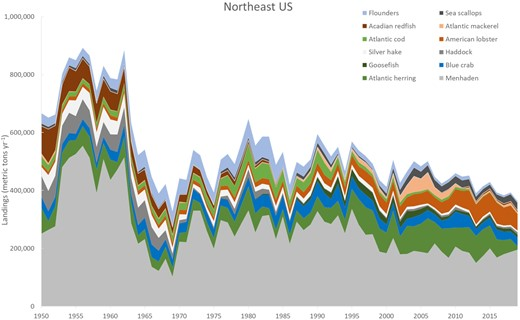
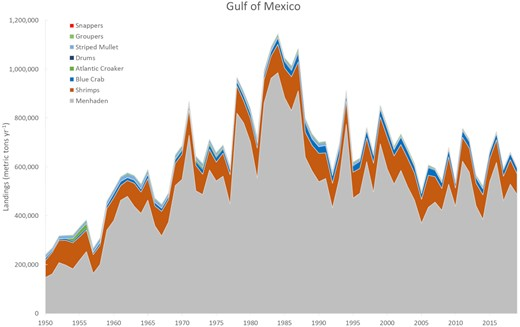
The grey on the bottom of both charts is menhaden. In the Atlantic, more than a quarter of all commercial landings is menhaden, or more than a billion fish every year. In the Gulf, a staggering 75% of all commercial landings are menhaden, about 3 billion fish. The Most Important Fish in the Sea. The foundation of the ecosystem. So, it is no wonder that ecosystem overfishing is occurring. Making matters worse is the fact that in the Atlantic the midwater trawl industry has collapsed herring and mackerel populations, putting further stress on the bottom of the marine food chain.
In 2019, Atlantic menhaden became the first species to be managed under an ecosystem management protocol, which made sense because of how many other species are dependent on it, from striped bass to osprey. The key to the ecosystem management model is striped bass. The model reflects the science showing that striped bass is the predator most highly sensitive to changes in menhaden abundance, so if enough menhaden are left in the water to sustain striped bass, there will be sufficient forage for other major predators, too.
The ASMFC set “targets” and “thresholds” based on the predator needs of striped bass.
The menhaden target and threshold are keyed to the striped bass reference points. The menhaden fishing mortality target (referred to as the ERP F Target) is the harvest level that allows striped bass to achieve its biomass target (assuming striped bass fishing mortality is at its target). For the first five years of menhaden management under the ERPs, the ASMFC set the menhaden Total Allowable Catch, or TAC, at levels that met the ERP target.
In 2025, the ASMFC admitted that it had botched the science in 2021 and set menhaden harvest quotas far too high. Striped bass are overfished, so the target level is the menhaden harvest that would let them rebuild to a sustainable population. To meet that target, the ASMFC scientists said that it would need to drop the quota from 233,550 metric tons to 108,000 mt. Instead, the commission set the TAC at a level, 186,840 mt, that had 0% chance of meeting the ERP target, content to manage at just 5% above the ERP overfishing threshold. It should also be noted that the 186,840 mt number, while a 20% cut on paper, was essentially the same amount that industry had been able to catch in 2024, so it did not require any actual harvest reduction.
On November 10, the ASMFC will again look at menhaden harvest and set quotas for the future. Its scientists now state that the quota needs to be reduced from 186,840 to 114,200 mt to meet the ecological target, namely giving striped bass a 50% chance of rebuilding (assuming striped bass are fished to their fishing mortality target).
Two caveats to this number. First, on September 16 new science was published showing that the ASMFC’s 2025 revised science still contains significant errors and likely overstates the size of the menhaden stock. Instead of using the new science and rerunning the corrected models, the commission claimed that 6 weeks did not give it enough time to do so. Really?
Second, why is it good enough to select a target number that only gives striped bass a 50% chance of rebuilding? A coin flip for America’s most valuable saltwater recreational fish, worth more than $7 billion to the economy annually and responsible for more than 100,000 jobs a decade ago? If you want to give striped bass a 60% chance of recovery, it would mean a quota of 110,200 mt.
Current science shows that the existing Atlantic menhaden fishery, of which about 65% is reduced by a single company in Reedville, VA, is responsible for suppressing striped bass populations from somewhere between 28% and 6%. That is significant; the most optimistic number, 6%, of the striped bass population is equivalent to the entire recreational and commercial harvest of striped bass.
No menhaden quota reduction is a panacea for striped bass, and recreational harvest, now at a 30-year low, is part of the picture too. But striped bass cannot rebuild from their overfished state if menhaden are not fished to their (F) target. An abundant menhaden resource is essential for striped bass recovery, and to end systemic ecosystem overfishing in the Atlantic.
Given the fact that only one state in the Atlantic still allows reduction fishing for menhaden (Virginia), perhaps we should do what every other state has done and end reduction fishing altogether and manage for abundance and ecosystem resilience.